What didn't hold up
Decision fatigue, the goldfish attention span, the trust hormone. The brain facts that failed when scientists tried to repeat them - and the ones that survived.
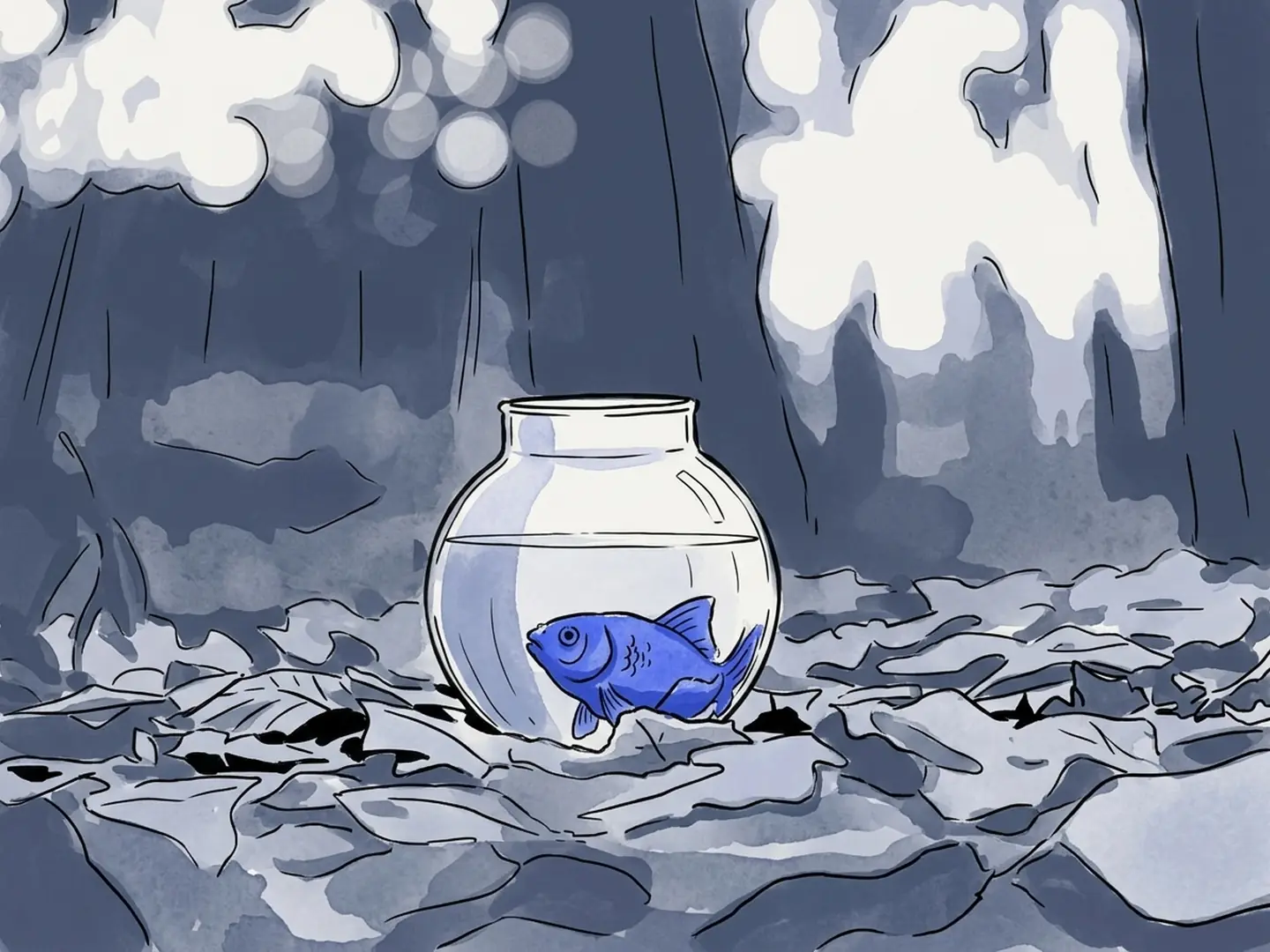

Cover: a goldfish in a small glass bowl. Photo: Ahmed Zayan, via Unsplash. Hover to see it.
For nearly two decades, one of the most cited ideas in psychology was that willpower is a resource that runs down as you use it. Researchers called it ego depletion. It explained why we make worse choices at the end of a long day, and it became the science behind “decision fatigue”.
In 2016, 23 labs ran the same ego-depletion experiment under a shared, preregistered plan, with 2,141 people taking part. The effect they found was d = 0.04, with a confidence interval that comfortably included zero.
Five years later, a team first-authored by Kathleen Vohs, one of the theory’s best-known researchers, tried again across 36 labs and 3,531 people. Again, there was no reliable effect. The results were about four times more likely if there was no effect at all.
If your marketing strategy assumes buyers suffer decision fatigue by the end of a long demo, you’re building on a finding that didn’t replicate - but more broadly, it’s worth checking whether pop science facts survive when someone else tries to repeat them.
Why this matters for marketers
Marketing loves a brain fact. It makes a slide feel scientific, and it’s hard to argue with a picture of a lit-up brain. But psychology and neuroscience have spent the last decade checking their own work - running big, preregistered, multi-lab replications of famous findings - and a surprising number didn’t survive.
In the first essay in this series I promised to say plainly what hasn’t held up. This essay is that list. It isn’t meant as cynicism. The findings that did survive are less dramatic, but they’re far more useful, because you can build on them.
So I’ve broken it into three parts: the attention myths, the trust and memory myths, and what did hold up.
1. The attention myths
The goldfish. You’ve probably seen the claim that our attention span has dropped to eight seconds, one second less than a goldfish’s. It traces back to a 2015 report by a division of Microsoft, which credited the numbers to a statistics website. When The Wall Street Journal tried to find the research behind them, the trail went cold. The listed sources couldn’t find it, and the psychologist Edward Vogel said his lab’s attention measures had been stable across decades.
What has changed is the competition. Across Twitter, books, films and search data spanning decades, topics now rise and fall faster, as more content competes for the same finite attention. That’s a different problem. Buyers can still concentrate - on what they’ve decided matters.
The phone on the desk. A 2017 study claimed that the mere presence of your own smartphone reduces working memory and fluid intelligence. A preregistered direct replication found no effect of where the phone was, and a meta-analysis of 56 effects found, at most, a small effect on working memory.
The multitasker. A 2009 study suggested heavy media multitaskers are worse at filtering out distraction. In two replications, only 5 of 14 tests came out significant, and a meta-analysis found a weak link that disappeared after correcting for small studies.
2. The trust and memory myths
The trust hormone. In 2005, a study in Nature found that a nasal spray of oxytocin made people more willing to trust in an investment game. “The trust hormone” has been in marketing talks ever since. A 2015 review concluded that the finding hadn’t reliably replicated. Then, in 2020, a large registered replication - co-authored by Ernst Fehr, one of the original researchers - found no effect of oxytocin on trust in the original set-up.
The Google effect. A 2011 study in Science suggested that when we expect information to be available online, we remember it less well. It was one of 21 social science studies from Nature and Science re-run in a large replication project, and it didn’t replicate. (The original authors replied that the context had changed, which is fair. But the headline result is no longer something to build on.)
Rewriting memories. A 2010 study in Nature reported that reactivating a fear memory just before new learning stopped the fear coming back - the basis for claims that you can “rewrite” a memory, brand memories included. A highly powered, preregistered direct replication found no benefit.
3. What did hold up
Here’s the good news. The findings that survived are behavioural, a little less exciting, and very usable.
Effort feels bad, nearly everywhere. A 2024 meta-analysis of 170 studies across 29 countries found mental effort is reliably experienced as unpleasant. Not because willpower runs out, but because effort is a cost people try to avoid. That’s a better explanation for a buyer abandoning a long form than decision fatigue ever was.
Repetition makes claims feel true. Repeating a statement made people rate it as truer even when they knew the right answer, and most of the gain comes from the second exposure. That’s why consistent messaging builds credibility - and why an unanswered claim from a competitor gets more believable each time a buyer meets it.
Spaced reminders beat bursts. In a study of more than 1,350 people, the best gap between reviews grew with how long the memory had to last, and randomised online ad experiments found spread-out exposures beat bunched ones.
Defaults shape choices. Across 58 studies and more than 73,000 people, defaults had a sizeable effect on what people chose - though it varied a lot by context.
I’ll come back to each of these in later essays, because each one changes how I think about a part of the B2B buying journey.
What good looks like
A few checks I’d run on any brain fact before it goes into a strategy:
- Find the original paper, not the slide. Most myths survive because nobody reads past the summary.
- Ask whether it’s been repeated. Ideally by a different team, preregistered, across several labs.
- Be wary of one small study with a big effect. That’s the profile of most of the findings above.
- Check who measured what. The goldfish came from a website, not a lab.
- Prefer behaviour over brain regions. What people actually did is stronger evidence than which part of their brain was active.
- Expect small effects. If a claim promises a dramatic lift from one psychological trick, it’s probably overstated.
For me, yes and no
There’s a fair challenge here. A failed replication doesn’t prove an effect is zero. Ego depletion might exist in a narrower form - the 2021 study found a small effect in an exploratory analysis that ignored its own exclusion rules. Oxytocin might matter for people who are low in trust, which the 2020 study hinted at but couldn’t confirm.
I agree that science moves in steps, and some of these effects may come back in a smaller, more conditional form.
But a finding that needs exploratory analyses to survive shouldn’t be steering a budget. For me, the bar for putting a brain fact in front of a leadership team is simple: has it held up when someone else tried to repeat it?
Where to start on Monday
- Audit your decks. Find every brain or psychology fact in your current presentations and trace each one to its original source.
- Swap one myth for a finding that held up. Replace “decision fatigue” with “effort is a cost”, and redesign one step of your buying journey around it.
- Add one question to your briefs. Ask agencies and vendors: has this been replicated, and where?
Three tests to run
- A shorter form might do more than a better-timed one. If effort is the cost, split your main gated asset: the control keeps the current form, the variant asks for half the fields and enriches the rest later. Run it for four to six weeks and measure form completion, plus MQL-to-SQL conversion to check lead quality holds.
- Hearing the same claim twice could make it more believable than hearing two different ones. Split webinar or content follow-up: one group gets a second touch that repeats your core claim within a fortnight, the other gets a new message. Measure reply rate and meeting rate on the sales follow-up.
- A suggested next step might get taken more often than an open question. Split event or webinar follow-up emails: the control asks when they’d like to talk, the variant proposes a specific meeting time they can accept or move. Measure meeting rate and time from the event to the first meeting.
Views are my own, not my employer’s.