Cards to strangers
A sociologist mailed Christmas cards to hundreds of strangers and got cards back for years. What the research says about reciprocity, why a gift wins a yes more than a signature, and where a gift becomes a bribe.
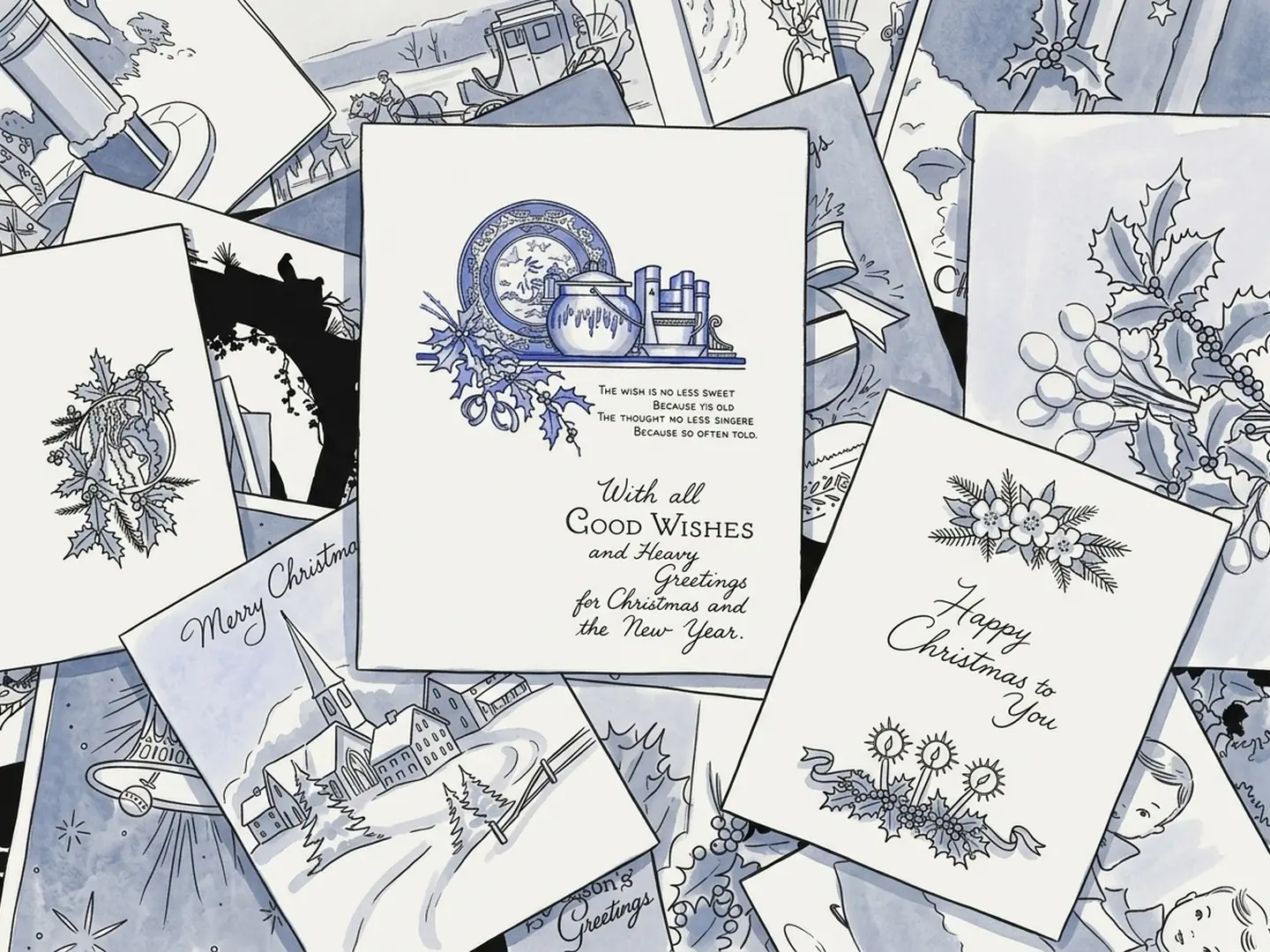

Cover: a pile of vintage Christmas cards. Photo: Annie Spratt, via Unsplash. Hover to see it.
In 1974, Phillip Kunz, a sociologist at Brigham Young University, picked names out of directories for some nearby towns and sent Christmas cards to people he’d never met.
About five days later, the replies started coming in, some of them letters three or four pages long. The family got cards for “maybe 15 years”, Kunz said, though most came in the first year or two.
Kunz told NPR in 2012 that he’d sent around 600 cards and got well over 200 replies. That’s his memory nearly 40 years on. The paper he wrote with Michael Woolcott is usually cited at a lower rate - about one in five recipients wrote back. (I couldn’t get hold of the original, so I’m going with the figure later researchers quote from it.)
But the twist is in the paper’s title: Season’s greetings: From my status to yours. By Tim Harford’s account of the study, some cards were expensive and signed “Dr and Mrs Phillip Kunz”, others were cheaper or signed with first names, and the fancy “Dr” cards did especially well with working-class households. A 2000 follow-up by Jenifer Kunz, with 590 cards, found the same pattern: a high-status sender raised the reply rate, especially among “blue-collar” recipients.
Gated ebooks lean on the same instinct. But the replies depended on the sender. So reciprocity is real, just smaller, shorter and more about the giver than the playbooks say.
What the research actually says
Cialdini’s rule is that we feel obliged to repay what others give us - even a gift we didn’t ask for, and often with something worth more. A lot of B2B marketing quietly runs on it: free content, free trials, free lunches, swag.
For me, it’s one of the sturdier principles. Cialdini’s own door-in-the-face study from 1975 (ask for something big, get refused, then retreat to something smaller) was run again in Germany 45 years later, and compliance was similarly high.
But the effects are smaller and shorter-lived than the stories, and the reason they work may not be the one the books give.
So I’ve broken it into three parts: what the gift research really shows, what it means for gated content and free trials, and where a gift becomes a bribe.
1. A gift gets a yes, not a signature
When Thomas Feeley, Ashley Anker and Ariel Aloe pooled 35 years of door-in-the-face studies, it raised what people said they’d do, but its effect on what they did was small and not statistically significant (r = .126 for saying yes, r = .052 for doing). Feeley’s 50-year update found a significant but still small effect on behaviour, at r = .08.
That’s the gap between a champion nodding in the meeting and procurement signing.
Then there’s the fade. In a 1997 experiment led by Jerry Burger, a free soft drink made people more willing to do a favour five minutes later. A week later, the effect had gone. When Uri Gneezy and John List paid workers a surprise higher wage, they worked harder for a few hours and then no harder at all, so the employer would have got more by paying the going rate.
And the explanation is shakier than the effect. Cialdini’s account is indebtedness: we comply because we owe. But when Ryan Goei and colleagues measured both, favours raised liking and obligation, and only liking predicted compliance. In a follow-up, Goei and Franklin Boster found that gratitude, not obligation, explained the effect. Both were small student studies, but the best B2B paper I found agrees. Robert Palmatier and colleagues found that a seller’s relationship investments create short-term gratitude that drives lasting reciprocal behaviour - purchase intent, sales growth and share of wallet.
I think that matters. People resent debt and try to clear it. Gratitude they build on.
2. Gated, ungated and free
This is where the playbooks get furthest ahead of the evidence. I couldn’t find a single peer-reviewed study testing whether ungated B2B content creates a sense of obligation in buyers. The claims come from vendors and practitioners, so treat them as hypotheses. What we do have is evidence by analogy.
Unconditional beats conditional. Allan Church’s meta-analysis of mail surveys found that rewards sent up front raised response rates by 19.1% (cash) and 7.9% (non-cash) over controls. Rewards promised on return showed no effect. A gated asset is a promised reward - the version that did nothing.
Thoughtful beats generic. Sebastian Kube, Michel Maréchal and Clemens Puppe found that at work, non-cash gifts beat cash of the same value. Cash only worked when the employer put effort into how it was given.
Gifts from strangers can look like a trick. When Brian Meier tried a version of the Christmas card study, sending cards to 755 people, only 2% sent one back. In a follow-up survey, suspicion of the sender went with being less likely to reply. Unsolicited swag to a cold list has the same problem.
Free trials are sampling, not gifts. Hannes Datta, Bram Foubert and Harald van Heerde found that customers who joined a digital TV service through a free trial had 59% lower average customer lifetime value than regular customers. That’s consumer data, so I wouldn’t read it straight across to B2B. But a trial earns its keep through use, not obligation.
For me, the honest case for ungated content isn’t reciprocity at all. It’s that buyers can read it, pass it round the rest of the buying group and come back when they’re ready. Gating it turns a gift into a transaction.
3. Where a gift becomes a bribe
The uncomfortable evidence is that expert, sceptical buyers aren’t immune.
Colette DeJong and colleagues matched US industry payment records to Medicare prescribing for 279,669 physicians. Ninety-five percent of the payments were meals, averaging under US$20. A single meal promoting a drug went with more prescribing of that brand (odds ratios of 1.18 to 2.18 across four drugs), and more or pricier meals went with more again. It’s an association, not proof of cause, as the authors say. But it’s hard to wave away.
That’s why procurement teams keep gift registers, and why the law draws lines. The UK’s Bribery Act guidance calls bona fide hospitality “an established and important part of doing business”. A Six Nations match at Twickenham for foreign clients is extremely unlikely to count as a bribe. But hospitality can be used as one, and the test is whether it was meant to induce someone to act improperly, judged by what a reasonable person in the UK would think.
Australia has gone further. Since 8 September 2024, a company can be guilty of failing to prevent the bribery of a foreign public official by its employees, agents or contractors, unless it had adequate procedures in place. The maximum penalty is the greatest of 100,000 penalty units, three times the benefit gained or 10% of annual turnover.
So where’s the line? For me, a gift is persuasion when it’s proportionate, given openly, comes with no strings, and would still feel fine if the buyer said no. It becomes manipulation when it’s designed to create a debt the buyer didn’t choose, timed to a decision, hidden from their organisation, or given to someone whose job is to be impartial.
And buying groups? I found no direct research on how a gift to one stakeholder plays out across a committee. But procurement exists partly to break exactly this loop. A gift that warms up your champion and alarms their compliance team hasn’t helped you.
What good looks like
A few golden rules I’d use to check whether giving is helping or hurting:
- Give without a gate. Up-front gifts worked in the survey research. Promised ones didn’t.
- Make it thoughtful, not lavish. Specific and useful beats generic and expensive.
- Give close to the ask. The effect fades in days, not quarters.
- Aim for gratitude, not debt. Help them do their job. Don’t make them feel they owe you.
- Count actions, not nods. A yes in the meeting after a concession isn’t a signature.
- Pass the procurement test. If you’d be uncomfortable with the buyer’s compliance team seeing the gift, don’t give it.
For me, yes and no
There’s a fair challenge here. Plenty of B2B teams swear by generous content and hospitality, and they can point to pipeline. Are they wrong?
Not entirely. When Armin Falk sent about 10,000 charity appeals, a large gift made donations 75% more frequent. Giving clearly works.
But that’s not the same as obligation working. People return gifts because they feel warmly towards the giver, for a short while, and more in words than deeds. Teams that build programmes around creating debt - gated assets, swag before a demo request, a lavish dinner just before a decision - are leaning on the weakest part of the effect, and the part regulators care about.
For me, reciprocity is a reason to be generous, not a lever to pull.
Where to start on Monday
- Audit your gates. For each gated asset, ask whether it’s a gift or a transaction, and test ungating one.
- Move a gift closer to the ask. Measure the gap between your best give-first moments and the next request, and shorten it.
- Check your hospitality against the buyer’s rules. Ask a friendly customer’s procurement team what they’d flag, and set your own gift policy to match.
Three tests to run
- A gift sent up front might work better than one promised on completion. For a customer survey or event registration drive, the control promises the report or benchmark once people respond, and the variant sends it with the ask. Compare response or registration rate over four to six weeks.
- A specific, useful gift could beat a more expensive generic one. In an account-based play to accounts already engaging with you, send half the standard swag and half something made for their problem, such as a short benchmark for their industry in your region. Measure reply rate and meetings booked within two weeks.
- Gratitude might get more replies than obligation. Split follow-up emails after an event or a useful asset: the control frames the next step as a return favour (“we’d appreciate a quick call in return”), the variant just offers more help and a link to book. Compare reply rate and meeting rate.
Views are my own, not my employer’s.